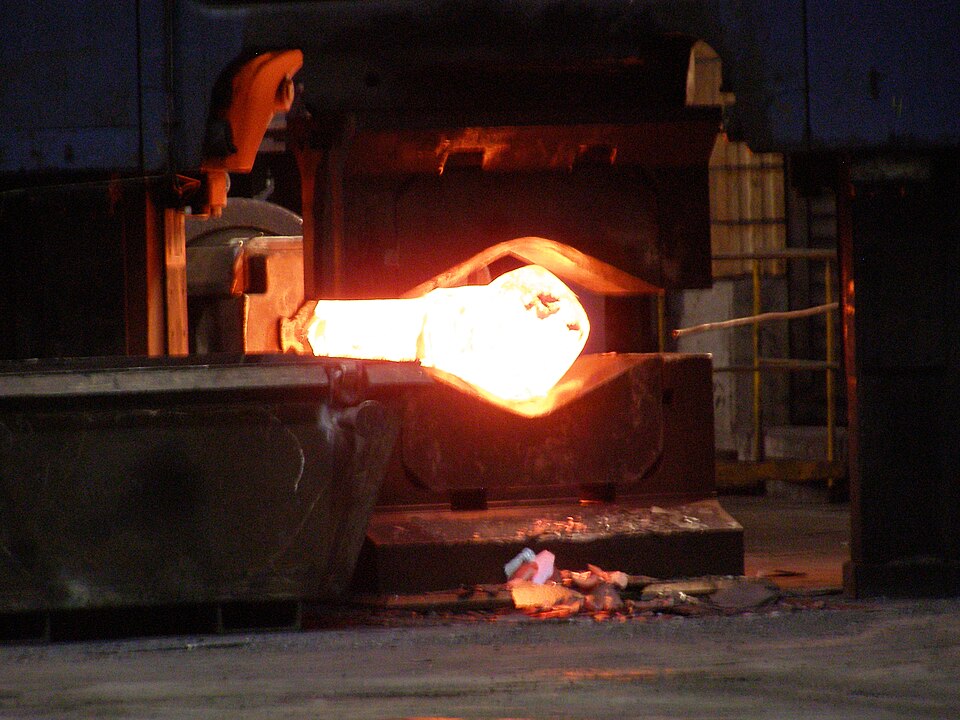
A forging or fabrication job moves through six real stages from order engineering to shipment. The list below is the same six stages used to plan every project in our portfolio.
-
01
Order engineering & billet selection
The drawing, load case, and any governing standard (ASTM, API, AMS, or a client spec) are reviewed, and the starting billet — alloy, diameter, and cut length — is selected against the finished part's projected area and required deformation ratio, not just its finished weight.
-
02
Furnace heating
The billet is soaked to forging temperature in a gas-fired or induction furnace and held long enough for the core to reach the same temperature as the surface — an underheated core forges unevenly and can crack, while overheating risks burning the grain structure at the surface before the core is even ready.
-
03
Forging — open-die, closed-die, or ring rolling
The heated billet is worked under a hydraulic press or hammer (open-die), driven into a shaped die impression (closed-die), or pierced and expanded on a ring mill (seamless rolled rings) — refining the as-cast grain structure into a directional, elongated grain flow that follows the part's shape, which is the entire metallurgical reason a forging outperforms an equivalent casting or machined-from-bar part under load.
-
04
Trimming & rough machining
Closed-die flash is trimmed, and the forging is rough-machined to a stock allowance that leaves enough material for final machining after heat treatment accounts for any distortion.
-
05
Heat treatment
Normalizing, quenching and tempering, or annealing is applied per the specified grade and property target — this is where a 4140 or 4340 forging actually reaches its published high-strength mechanical properties; an as-forged part in these grades is considerably softer than its quenched-and-tempered spec.
-
06
NDT, final inspection & documentation
Ultrasonic testing (UT) for internal soundness, magnetic particle (MT) or dye penetrant (PT) inspection for surface and near-surface defects, and dimensional and hardness checks are performed and documented, with full material traceability back to the original heat lot before the part ships.
Why grain flow is the entire point
A forging isn’t just steel shaped by pressure — the real metallurgical benefit is that forging deforms and refines the as-cast grain structure into a continuous, directional grain flow that follows the part’s shape. A shaft machined from bar stock, or a ring cut from flat plate, has grain flow that gets interrupted wherever the machining cuts across it; a properly forged shaft or rolled ring has grain flow running with the part’s load path essentially end to end. That difference shows up directly in fatigue life and impact toughness under real service loads, which is exactly why critical rotating and load-bearing components in aerospace, energy, and marine service are specified as forgings rather than castings or bar stock in the first place.
Open-die vs. closed-die vs. seamless rolled rings
Open-die forging shapes the billet between flat or simply-contoured dies with no fixed impression — well suited to large, relatively simple shapes (shafts, blocks, discs) where the press tonnage required stays comparatively low and tooling cost is minimal, but the geometry is limited to what open-die working can achieve. Closed-die forging drives the billet into a shaped die cavity, producing near-net-shape geometry with tighter tolerances and more complex profiles, at the cost of much higher press tonnage and dedicated die tooling — worthwhile once part complexity or production volume justifies the die cost. Seamless ring rolling pierces a forged donut-shaped blank and expands it on a ring mill between rolls, producing a ring with continuous circumferential grain flow and no weld seam — the standard method for flanges, bearing races, and gear blanks where that grain-flow orientation matters most.